Look both ways!
Don't wanna die in a crosswalk

I’ve made a personal vow, as I am now an official senior citizen, not to die in a crosswalk. I do my best to avoid negative outcomes where there is pretty good data: according to the CDC, seniors make up about 17% of the U.S. population but account for 22% of all pedestrian deaths. When you account for the fact that seniors walk less than younger population groups, the likelihood of a senior dying as a pedestrian is more than double that of a younger person.
It is true that senior pedestrians are less often victims of accidents than younger population groups because children run around mindlessly and younger adults mindlessly look at cell phones while crossing the street, but if a senior is struck by a vehicle they are much more likely to die.
I was vaguely aware of these statistics before moving to Korea for two years, but observing their traffic infrastructure drove home the point.
South Korea, and Seoul specifically, used to be a much more dangerous place for pedestrians, seniors in particular. It wasn’t long ago that South Korea was like other developing countries, where traffic infrastructure and enforcement were pretty minimal. Therefore, lots of people died.
As South Korea became richer, they made major investments in public transit and traffic infrastructure and there was a consequent dramatic drop in pedestrian deaths and injuries. Seniors there remain at disproportionately higher risk of injury and death, but the rates are dropping. Pedestrian fatalities have dropped by 60% in less than two decades, while they have increased in the US.
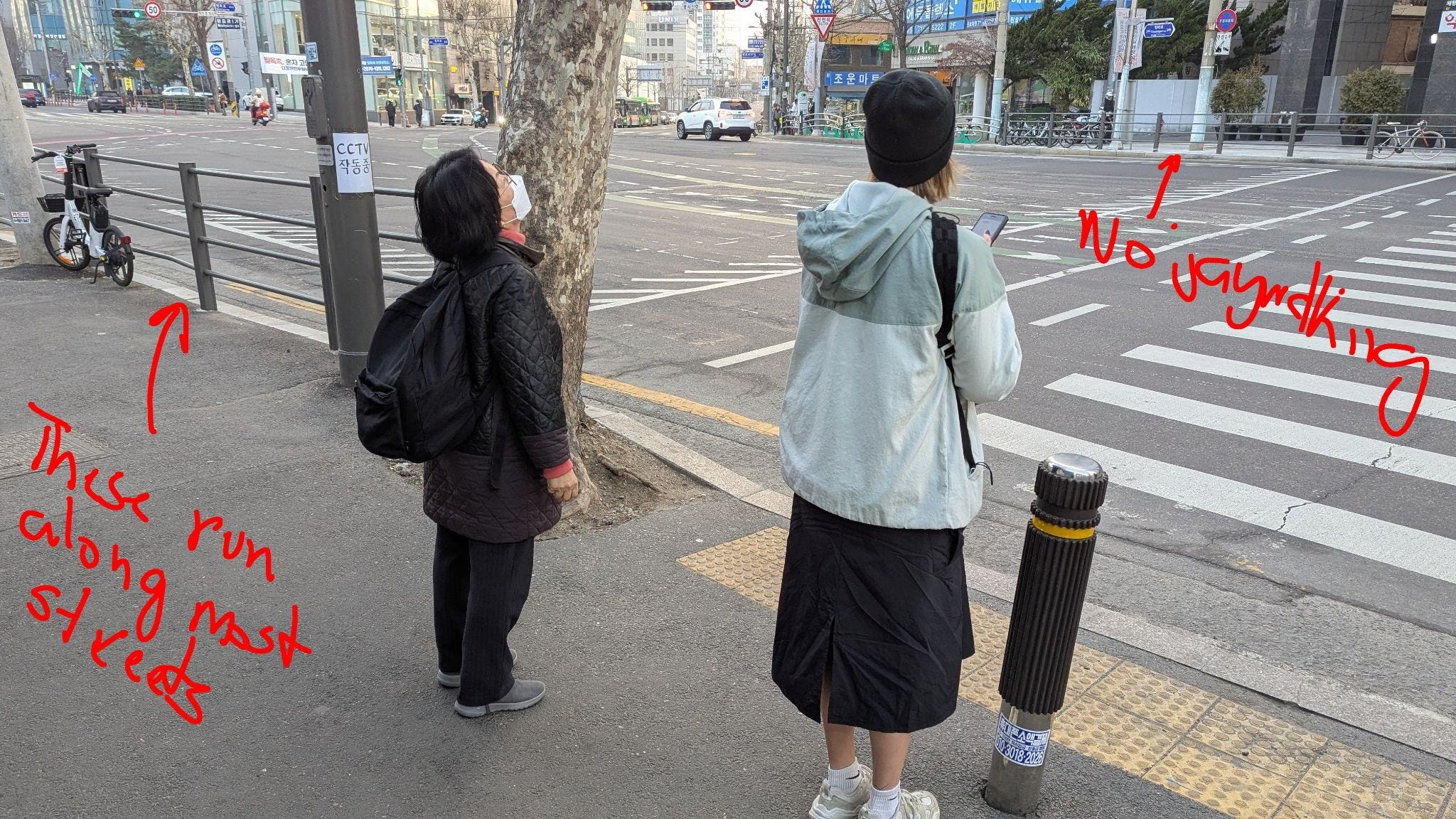
Visitors to Seoul are often amazed by what they interpret as obedient, rule-following Koreans waiting for lights to turn, crossing in cross walks, following the many pointers toward correct behavior: lights, signage, security cameras everywhere.
While most people notice the red and green lights embedded in the sidewalk as an additional crossing signal, I think the anti-jaywalking barriers are the most dramatic sign of an effort to make people safer.
The other, more important factor, is much lower speed limits, especially near schools and senior centers, combined with traffic cameras and citations.
These infrastructure tools do two things: they vividly convey the behavior desired, and they make it hard to do the wrong thing and easy to do the right thing.
People love to make cultural observations based on driving/pedestrian behavior, drawing conclusions about respect for rules, appreciation for elders, or daily civility. Whether it’s Los Angeles, Pittsburgh or San Antonio, or Seoul, Paris or Buenos Aires, people have conversations about driving behaviors like, “Everybody drives like a maniac here!”
“Oh yeah, Los Angeles has the worst drivers.”
That dialogue completely misses the point.
General driver behavior is downstream from infrastructure, which includes enforcement. There’s always going to be people who refuse to follow the rules and put themselves and other people at risk, but good infrastructure and enforcement make those people rarer outliers.
Look no further than the dramatic change that happened in Seoul. Whatever you want to believe about Korean respect for elders, civility and obedience, those values haven’t increased in the last twenty years; they invested in infrastructure to make it safer to move around the city.
If culture is relevant to traffic safety, it’s only in the sense that one culture invests in infrastructure to make moving around safer, and another culture does not make those investments. One culture decides that thousands of people being mauled or killed on roadways is fine, and another culture decides that it’s worth investing in decreasing those numbers.
It takes politics to get a culture to recognize that constraining and directing transportation to favor safety and access over speed and “freedom.”
The next time you get into the conversation about how people in New Jersey drive like maniacs, how there appear to be no traffic laws in Delhi, or that drivers constantly speed in your neighborhood, look around at how the transportation infrastructure is built, what transportation options are available and what enforcement systems are in place. Then you’ll know how safe a city is to walk around in, senior or not.
This is something that we should surely work to improve right here is Menlo Park, CA.! Thank you for writing such an insightful article. As a Senior Citizen, I admit to being more than a little nervous when needing to cross El Camino Real when out for an occasional walk to Barrone’s.